
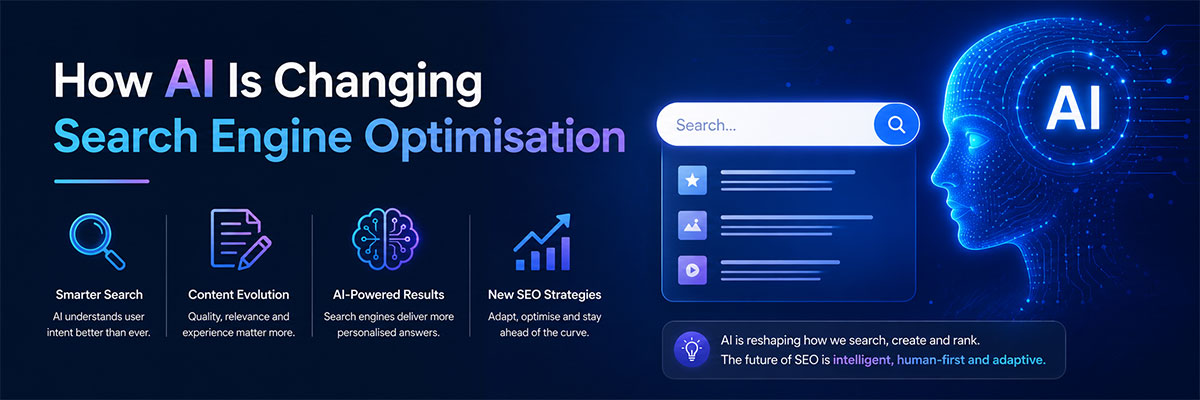
Search Engine Optimisation (SEO) has always been about helping websites rank higher on search engines and attract more organic traffic. However, the SEO landscape is changing rapidly, and one of the biggest driving forces behind this transformation is Artificial Intelligence (AI).
From search algorithms to content creation and user experience, AI is reshaping how websites are discovered online. Businesses that understand and adapt to these changes are gaining a significant competitive advantage, while those relying on outdated SEO tactics risk falling behind.
So, how exactly is AI changing SEO, and what does it mean for businesses looking to improve their online visibility? Let’s explore.
Understanding AI in SEO
Artificial Intelligence refers to computer systems that can analyse data, learn patterns, and make decisions with minimal human intervention.
Search engines such as Google have been using AI for several years to improve the quality and relevance of search results. AI helps search engines better understand:
- User intent
- Search behaviour
- Content quality
- Website relevance
- User experience signals
This means SEO is no longer just about inserting keywords into a webpage. Today’s SEO focuses on delivering valuable, relevant, and user-friendly content.
AI Helps Search Engines Understand User Intent
One of the biggest advancements in SEO is Google’s ability to understand what users actually mean when they perform a search.
Previously, search engines mainly matched exact keywords. Today, AI-powered algorithms can understand:
- Context
- Search intent
- Synonyms
- Natural language
For example, if someone searches for “best laptop for working from home”, Google understands that the user wants recommendations, reviews, and buying advice rather than pages simply repeating those keywords.
As a result, businesses must focus on creating content that answers user questions rather than simply targeting keywords.
Content Quality Matters More Than Ever
AI has made search engines much better at identifying high-quality content.
Google now evaluates:
- Relevance
- Originality
- Expertise
- Trustworthiness
- User engagement
Websites that publish useful, informative, and well-structured content are more likely to rank higher.
This shift has reduced the effectiveness of old SEO practices such as:
- Keyword stuffing
- Duplicate content
- Low-quality articles
- Spammy backlinks
Modern SEO requires creating content that genuinely helps users solve problems and find information.
AI-Powered Search Results Are Evolving
The way people search online is changing.
AI-powered search experiences now provide:
- Featured snippets
- Knowledge panels
- Voice search answers
- AI-generated search summaries
These features often provide immediate answers directly within search results.
To remain visible, businesses need to optimise content for:
- Question-based searches
- Conversational keywords
- Structured data
- Featured snippet opportunities
Content that is clear, concise, and well-organised has a better chance of appearing in these prominent positions.
Voice Search Is Influencing SEO
Voice assistants and smart devices have made voice search increasingly popular.
People speak differently from how they type. For example:
Typed search:
“SEO agency London”
Voice search:
“Which is the best SEO agency in London for small businesses?”
AI helps search engines understand these natural language queries.
Businesses should therefore focus on:
- Long-tail keywords
- Frequently asked questions
- Conversational content
- Local SEO optimisation
This approach helps capture voice search traffic and improve visibility.
AI Improves SEO Analysis and Strategy
AI-powered tools are helping marketers make smarter SEO decisions.
These tools can analyse:
- Keyword opportunities
- Competitor performance
- Search trends
- User behaviour
- Technical SEO issues
Instead of spending hours manually reviewing data, businesses can use AI insights to identify opportunities faster and optimise their SEO strategies more effectively.
This allows marketers to focus on planning and creativity while AI handles data analysis.
Personalisation Is Becoming More Important
AI enables search engines to deliver more personalised search results based on:
- Location
- Search history
- Device type
- User preferences
As personalisation increases, businesses need to focus on creating content that serves specific audience segments.
Understanding customer needs and search intent is becoming just as important as traditional keyword research.
User Experience Is a Ranking Factor
Google’s AI systems increasingly evaluate how users interact with websites.
Important ranking factors now include:
- Page loading speed
- Mobile responsiveness
- Easy navigation
- User engagement
- Content accessibility
A website that provides a positive user experience is more likely to rank well.
This means SEO and website design are now closely connected.
The Future of AI and SEO
AI will continue to transform SEO in the coming years.
Future trends may include:
- More advanced AI-generated search results
- Greater emphasis on user intent
- Improved voice and visual search
- Enhanced content personalisation
- Smarter predictive search experiences
Businesses that embrace these changes early will be better positioned to maintain strong search visibility.
However, while AI can automate many tasks, human creativity, expertise, and strategic thinking remain essential for successful SEO.
Final Thoughts
Artificial Intelligence is fundamentally changing the way search engines evaluate and rank websites. Modern SEO is no longer focused solely on keywords and backlinks. Instead, it revolves around understanding user intent, creating valuable content, delivering excellent user experiences, and leveraging data-driven insights.
Businesses that adapt their SEO strategies to align with AI-driven search trends can improve visibility, attract more qualified traffic, and achieve sustainable online growth.
For organisations looking to stay ahead in this evolving digital landscape, professional digital marketing agencies like Vizcom provide expert SEO, AI-driven marketing strategies, website optimisation, content creation, and digital growth solutions. With the right combination of technology and expertise, agencies like Vizcom help businesses maximise their online presence and achieve long-term success.