
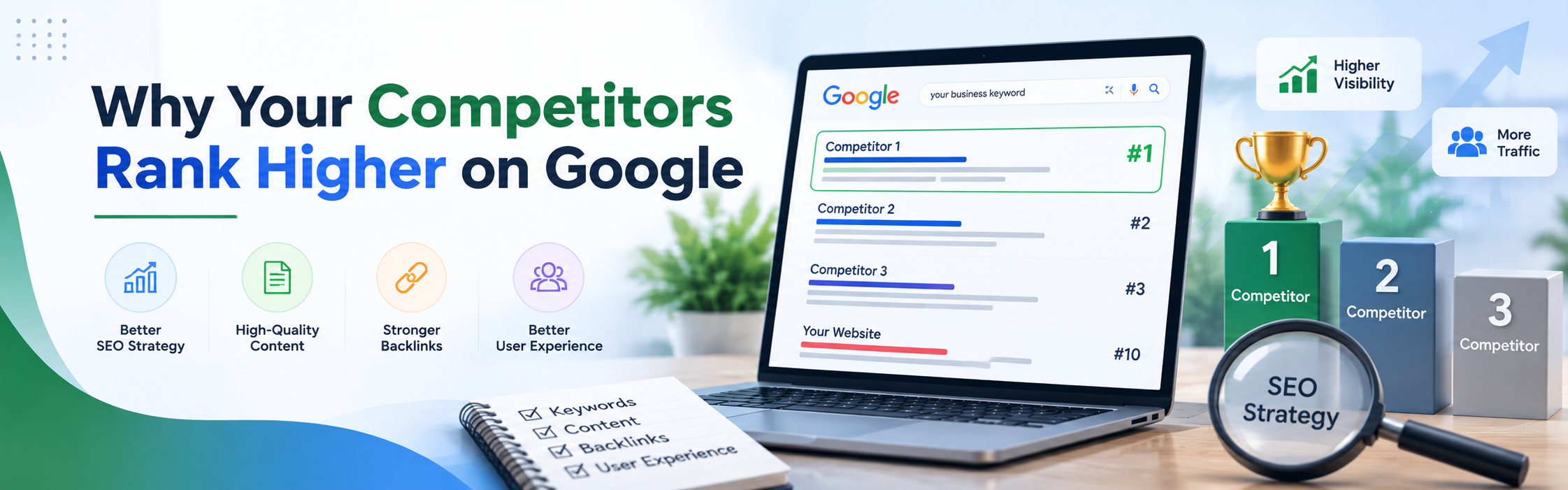
You search for your products or services on Google and see your competitors appearing above your website. You have a professional website, you publish content and you may even be investing in digital marketing. So why are they ranking higher?
Higher search rankings are not usually the result of one single factor. Search engines consider many signals, including content relevance, website structure, technical performance, user experience, authority and how well a page matches what people are searching for.
If your competitors consistently rank above you, it may be because their websites are doing some of these things better.
Here are some common reasons your competitors may be ranking higher on Google and what you can do about them.
1. Your Competitors Understand Search Intent Better
People search Google with a specific purpose. They may want to find information, compare options, solve a problem or choose a service provider.
Your competitors may be creating pages that better match what their target audience actually wants to find.
For example, someone searching for “corporate website design services” may be looking for a service page rather than a general article about website design.
Focus on:
- Understanding what your customers are searching for
- Identifying the purpose behind each search
- Creating pages that directly answer those needs
- Matching content to different stages of the customer journey
The goal is not simply to use the right keywords. It is to provide the right answer.
2. Their Content Provides More Value
A website can contain many pages and still provide little useful information.
Your competitors may rank higher because their content is more detailed, more relevant or more useful to the people searching.
Useful content can include:
- Detailed service pages
- How-to guides
- FAQs
- Industry insights
- Case studies
- Original research
- Helpful blog articles
The goal should not be to publish content simply to have more pages. Create content that genuinely helps your audience.
3. Their Website Is Better Optimised for Relevant Keywords
Using keywords is still important, but keyword selection matters more than simply adding as many keywords as possible.
Your competitors may be targeting more relevant and specific searches.
Look at:
- Primary keywords
- Long-tail keywords
- Industry-specific terms
- Location-based searches
- Question-based searches
- Keywords aligned with customer needs
For example, a business may struggle to compete for a broad term such as “digital marketing” but may have a better opportunity with a more specific search related to its service, industry or location.
The goal is to attract the right audience rather than simply chase high search volume.
4. Their Website Has a Stronger Technical Foundation
SEO is not only about content.
Technical factors can influence how effectively search engines crawl, understand and index your website.
Review areas such as:
- Page loading speed
- Mobile responsiveness
- Website structure
- Internal linking
- Metadata
- Broken links
- URL structure
- Indexing issues
A technically strong website creates a better foundation for your content and makes it easier for search engines to understand your pages.
5. Their Website Provides a Better User Experience
Search visibility and user experience are closely connected.
If your website is difficult to navigate, slow to load or difficult to use on mobile devices, visitors may leave quickly.
Review your:
- Navigation
- Page layouts
- Mobile experience
- Readability
- Calls to action
- Page speed
- Overall website usability
Your website should help visitors find what they need without unnecessary friction.
A better experience can also help turn organic visitors into meaningful enquiries.
6. They Have Built Greater Website Authority
Search engines consider the credibility and authority of websites when determining rankings.
Your competitors may have stronger authority because other relevant and reputable websites link to their content.
You can work towards building authority through:
- Digital PR
- Industry partnerships
- Guest articles
- Business directories
- Original research
- Valuable content
- Relevant backlinks
The focus should be on earning credible and relevant links rather than collecting large numbers of low-quality backlinks.
7. They Have More Relevant Content Covering the Topic
Your competitor may have one strong page ranking for a topic while also having several supporting pages that cover related questions and subtopics.
For example, a business offering website development could create content around:
- Website design
- User experience
- Website development
- Website performance
- Mobile optimisation
- SEO
- Website security
Creating useful content across related topics can help establish broader relevance around an area of expertise.
The objective is not to create content for search engines alone. It is to build a useful resource for your audience.
8. They Optimise Their Pages More Effectively
Even good content can underperform when basic on-page SEO elements are overlooked.
Review:
- Page titles
- Meta descriptions
- Heading structure
- Image alt text
- Internal links
- Keyword placement
- Content structure
- URLs
These elements help search engines understand what each page is about.
More importantly, they help users quickly understand what they will find when they visit the page.
9. They Keep Improving Their Website
SEO is not a one-time activity.
Your competitors may be regularly updating content, improving technical performance, adding new pages and analysing search results.
Review your website regularly for:
- Outdated content
- Declining rankings
- New keyword opportunities
- Broken links
- Poor-performing pages
- Changes in user behaviour
- New questions from your audience
Small improvements made consistently can be more effective than occasional large SEO campaigns.
10. They Are Measuring What Works
Without data, it is difficult to understand why one website is outperforming another.
Track metrics such as:
- Organic traffic
- Search rankings
- Traffic sources
- Click-through rates
- Popular landing pages
- Bounce rates
- Conversion rates
- Search queries
This information can help you identify which pages are attracting visitors, which keywords are performing and where opportunities exist.
The goal is not simply to rank higher. It is to attract relevant visitors who are more likely to become customers.
A Better Approach to Beating the Competition
Ranking above your competitors is not about finding one SEO trick.
It requires a combination of:
Relevant keywords + useful content + technical SEO + strong user experience + website authority + continuous improvement + analytics
Start by understanding where your competitors are stronger.
Look at the keywords they rank for, the topics they cover, the quality of their pages, their website experience and the authority they have built.
Then identify the gaps in your own website and prioritise improvements based on your business goals.
The objective is not simply to copy your competitors. It is to build a better and more useful digital experience for your audience.
Final Thoughts
Your competitors may be ranking higher because they are doing several small things better rather than one thing dramatically differently.
They may have stronger content, better keyword targeting, a faster website, a better user experience or greater online authority.
The good news is that search performance can be improved.
By combining SEO, useful content, technical optimisation, user experience and data-driven improvement, businesses can strengthen their online visibility and compete more effectively in search.
For businesses looking to improve their search presence, Vizcom provides SEO, content marketing, website design, digital strategy and other digital marketing solutions designed to help brands improve visibility, attract relevant audiences and create meaningful business opportunities.