The healthcare industry is evolving at an incredible pace, and so is the way complex medical information is communicated. In 2026, medical animation has become an essential tool for hospitals, pharmaceutical companies, medical device manufacturers, biotechnology firms, healthcare educators, and digital health brands. By transforming complicated scientific concepts into engaging visual stories, medical animations help audiences understand intricate topics quickly and accurately.
Whether explaining a surgical procedure, demonstrating how a new drug works, or educating patients about a medical condition, high-quality medical animation is making healthcare communication more effective than ever before.
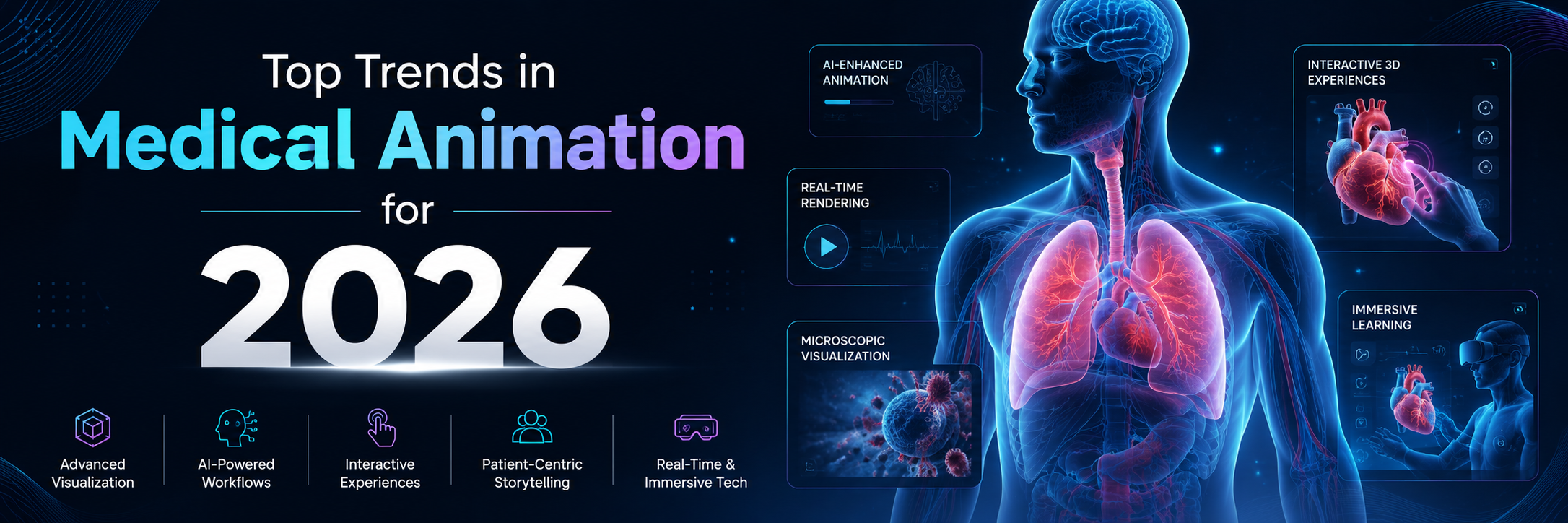
As technology continues to advance, several exciting trends are shaping the future of medical animation. Here are the top medical animation trends businesses should watch in 2026.
1. AI-Powered Medical Animation
Artificial Intelligence is transforming the animation industry by speeding up production while maintaining high levels of accuracy and visual quality.
AI-powered tools are helping animation studios:
- Generate realistic medical visuals
- Automate repetitive design tasks
- Improve animation workflows
- Enhance voiceovers and subtitles
- Personalise educational content
While human expertise remains essential for scientific accuracy, AI is making medical animation production faster, more efficient, and more cost-effective.
2. Hyper-Realistic 3D Visualisations
Healthcare companies are increasingly moving beyond traditional 2D graphics in favour of highly detailed 3D medical animations.
Advanced rendering technology now allows creators to produce realistic visualisations of:
- Human anatomy
- Cellular processes
- Surgical procedures
- Medical devices
- Drug delivery mechanisms
These detailed animations help healthcare professionals, investors, and patients better understand complex biological processes that would otherwise be difficult to explain.
3. Personalised Patient Education
Every patient has different medical needs and levels of understanding. In 2026, personalised medical animations are becoming more common.
Healthcare providers are using customised animations to explain:
- Individual treatment plans
- Surgical procedures
- Rehabilitation programmes
- Medication instructions
- Chronic disease management
Personalised educational content helps patients make informed decisions while improving treatment adherence and overall satisfaction.
4. Interactive Medical Learning Experiences
Medical education is becoming increasingly interactive.
Instead of simply watching animations, students and healthcare professionals can now engage with digital models that allow them to:
- Rotate organs in 3D
- Explore anatomical structures
- Simulate surgical procedures
- Understand disease progression
- Study complex physiological systems
Interactive medical animation creates a more engaging learning experience and improves knowledge retention.
5. Medical Animation for Pharmaceutical Marketing
Pharmaceutical companies are investing heavily in medical animation to explain complex therapies and new drug innovations.
Medical animations are widely used for:
- Mechanism of Action (MoA) videos
- Drug launch campaigns
- Clinical trial presentations
- Investor communications
- Healthcare professional training
These animations simplify scientific information while ensuring accuracy and regulatory compliance.
As pharmaceutical innovation continues to accelerate, demand for professional medical animation is expected to grow significantly.
6. Short-Form Medical Videos for Social Media
Healthcare organisations are increasingly using social media to educate patients and build public awareness.
Short animated videos are proving highly effective on platforms such as:
- YouTube
- X
Topics often include:
- Preventive healthcare
- Disease awareness
- Medical myths
- Wellness advice
- Product demonstrations
Short-form animations capture attention quickly and make complex medical topics easier to understand for broader audiences.
7. Virtual Reality (VR) and Augmented Reality (AR) Integration
Immersive technologies are becoming an important part of medical animation.
Virtual Reality and Augmented Reality are now being used for:
- Surgical planning
- Medical training
- Anatomy education
- Patient consultations
- Clinical simulations
Doctors can practise complex procedures in virtual environments, while patients gain a better understanding of upcoming treatments through immersive visual experiences.
As VR and AR technology becomes more accessible, their role in healthcare communication is expected to expand.
8. Greater Focus on Scientific Accuracy
As healthcare regulations become stricter, scientific accuracy has become a top priority.
Medical animation studios are increasingly collaborating with:
- Doctors
- Surgeons
- Pharmacists
- Researchers
- Medical illustrators
This collaborative approach ensures that animations remain medically accurate while still being visually engaging.
Accuracy is especially important for pharmaceutical marketing, medical education, and regulatory submissions.
9. Multi-Language Medical Content
Healthcare organisations increasingly serve global audiences.
Medical animations are now being produced in multiple languages with:
- Localised voiceovers
- Regional subtitles
- Cultural adaptations
- Accessible visual communication
This helps pharmaceutical companies, hospitals, and healthcare providers communicate effectively across different countries and patient populations.
10. Data-Driven Healthcare Storytelling
Medical animation is evolving beyond visual explanation into data-driven storytelling.
Healthcare companies are combining:
- Clinical research
- Medical data
- Patient outcomes
- Scientific evidence
- Animated visualisations
to create compelling presentations that communicate complex findings clearly to healthcare professionals, investors, and patients.
This combination of storytelling and evidence-based communication helps build trust and improve understanding.
Why Medical Animation Is Becoming Essential
Medical information is often highly technical and difficult for non-specialists to understand.
Medical animation helps organisations:
- Simplify complex concepts
- Improve patient education
- Enhance medical training
- Support pharmaceutical marketing
- Increase audience engagement
- Build credibility and trust
As digital healthcare continues to expand, organisations that invest in professional medical animation will be better positioned to educate, inform, and engage their audiences.
Final Thoughts
Medical animation is rapidly transforming healthcare communication in 2026. From AI-powered production and realistic 3D visualisations to personalised patient education and immersive VR experiences, the future of medical animation is becoming more innovative, interactive, and impactful.
For healthcare providers, pharmaceutical companies, biotechnology firms, and medical device manufacturers, investing in high-quality medical animation is no longer just a creative choice it is a strategic advantage that enhances education, improves engagement, and strengthens brand credibility.
For organisations looking to create compelling medical animations and digital healthcare campaigns, professional digital marketing agencies like Vizcom offer end-to-end creative solutions. From medical animation and healthcare branding to website development, SEO, video production, and digital marketing, Vizcom helps healthcare brands communicate complex medical information with clarity, creativity, and measurable impact.